THE ILLUSION OF AXES, PHENOMENAL TRANSPARENCY MEMORIAL


Project idea
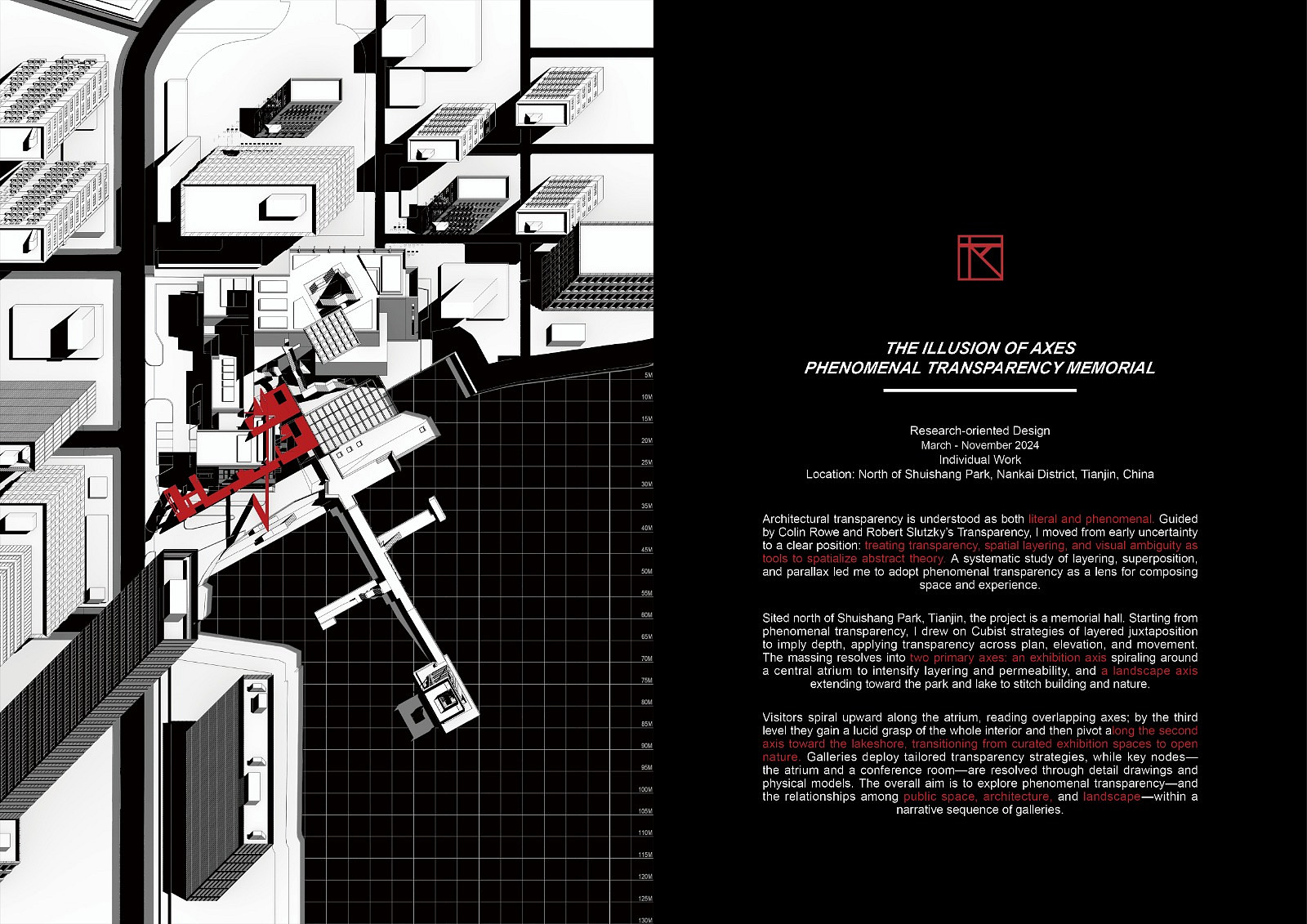
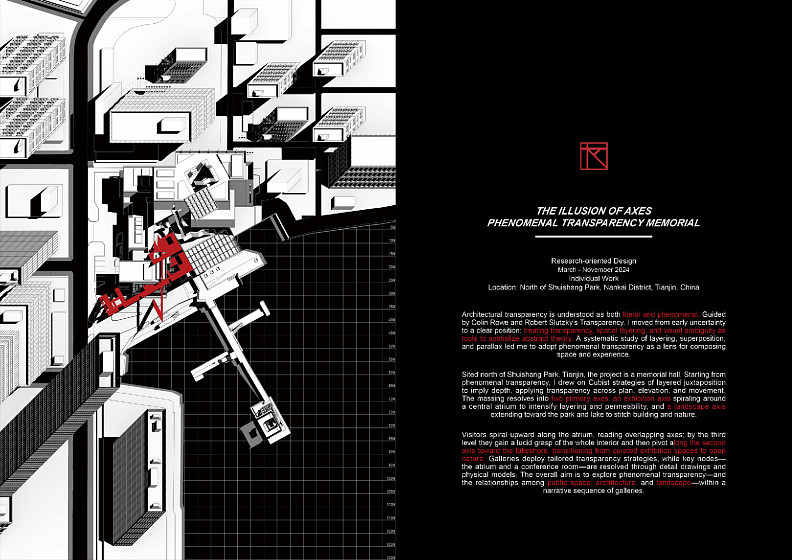
The project explores the spatial relationship between axis, perception, and phenomenal transparency. Inspired by Colin Rowe’s theory of “phenomenal transparency,” the design investigates how multiple spatial systems can coexist and overlap without being physically transparent.
Rather than relying on literal openness, the project constructs layered spatial sequences through the superposition of axes, shifting perspectives, and controlled visual connections. The aim is to create an architectural experience where movement, memory, and perception interact dynamically.
The project seeks to reinterpret classical compositional order within a contemporary architectural language, questioning how structure and space can generate ambiguity while maintaining clarity of organization.
Project description
The project consists of several interrelated spatial systems organized through primary and secondary axes. The main spatial sequence is structured along a dominant axis, while subsidiary axes intersect and overlap to generate layered circulation paths and visual corridors.
The design integrates public and semi-public spaces, creating transitional zones that mediate between interior and exterior environments. Plans, sections, and spatial diagrams demonstrate the superimposition of structural grids and perceptual axes.
Through controlled openings, framed views, and shifting volumes, the project establishes a dynamic relationship between solid and void. The architectural form responds to its context while maintaining an internal geometric order.
Technical information
The project adopts a reinforced concrete structural system combined with steel structural elements in key spanning areas. The structural grid follows the main compositional axes, ensuring consistency between spatial concept and construction logic.
Facade materials include glass panels and solid cladding to emphasize the contrast between transparency and opacity. The building envelope is designed to optimize natural lighting and ventilation while maintaining thermal performance.
The construction system allows flexibility in interior spatial organization and supports the layered spatial composition central to the design concept.
Documentation


Copyright © 2026 INSPIRELI | All rights reserved. Use of this website signifies your agreement to the Terms of Use, Privacy Policy, and use of cookies.