GASTRO - HUB


 Assist. Prof. Dr. Gizem Özkan Üstün (Ph.D.)
Project idea
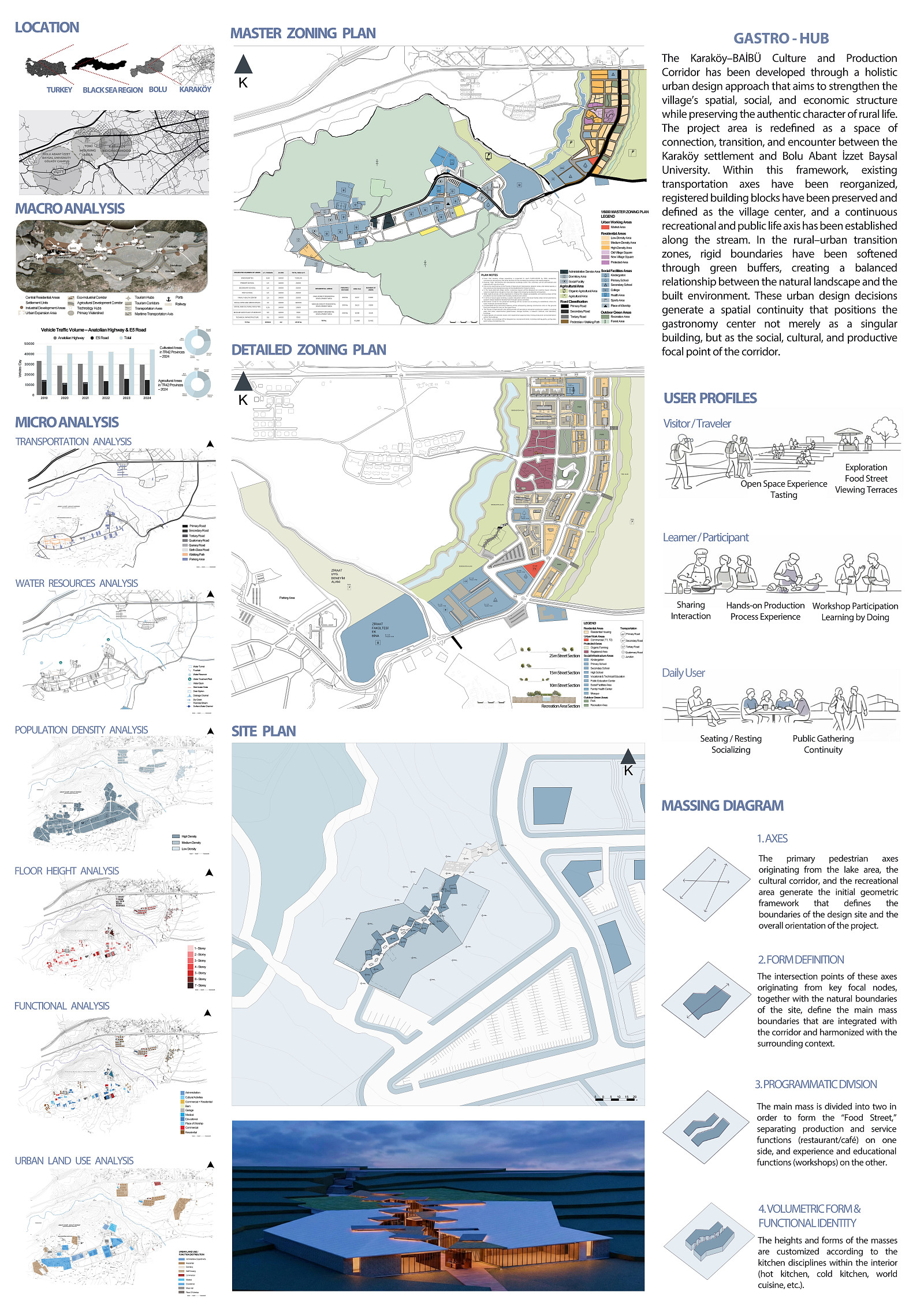
The Gastro Hub Project is a holistic spatial development proposal that aims to strengthen social, cultural, and economic interaction between Karaköy and Bolu Abant İzzet Baysal University. The project seeks to establish a sustainable interaction corridor by bringing rural production culture together with academic knowledge and public life.
In this context, the design creates not merely a physical connection between the village and the university, but a public living axis that supports processes of learning, production, experience, and sharing. The Gastronomy Center, which forms the architectural focal point of the corridor, is conceived as a production and experience hub that redefines gastronomy beyond consumption-oriented activity, integrating it with education, practice, and social interaction.
The project aims to present a sustainable and user-oriented living model in rural–urban transition zones by developing a spatial framework that is compatible with the natural environment, topography, and local cultural values.
Project description
The Gastro Hub Project is designed as the architectural focal point of the culture and production corridor established between the Karaköy settlement and Bolu Abant İzzet Baysal University. The project approaches gastronomy not only through food and beverage activities, but as a holistic spatial organization that brings together production, education, experience, and social interaction processes.
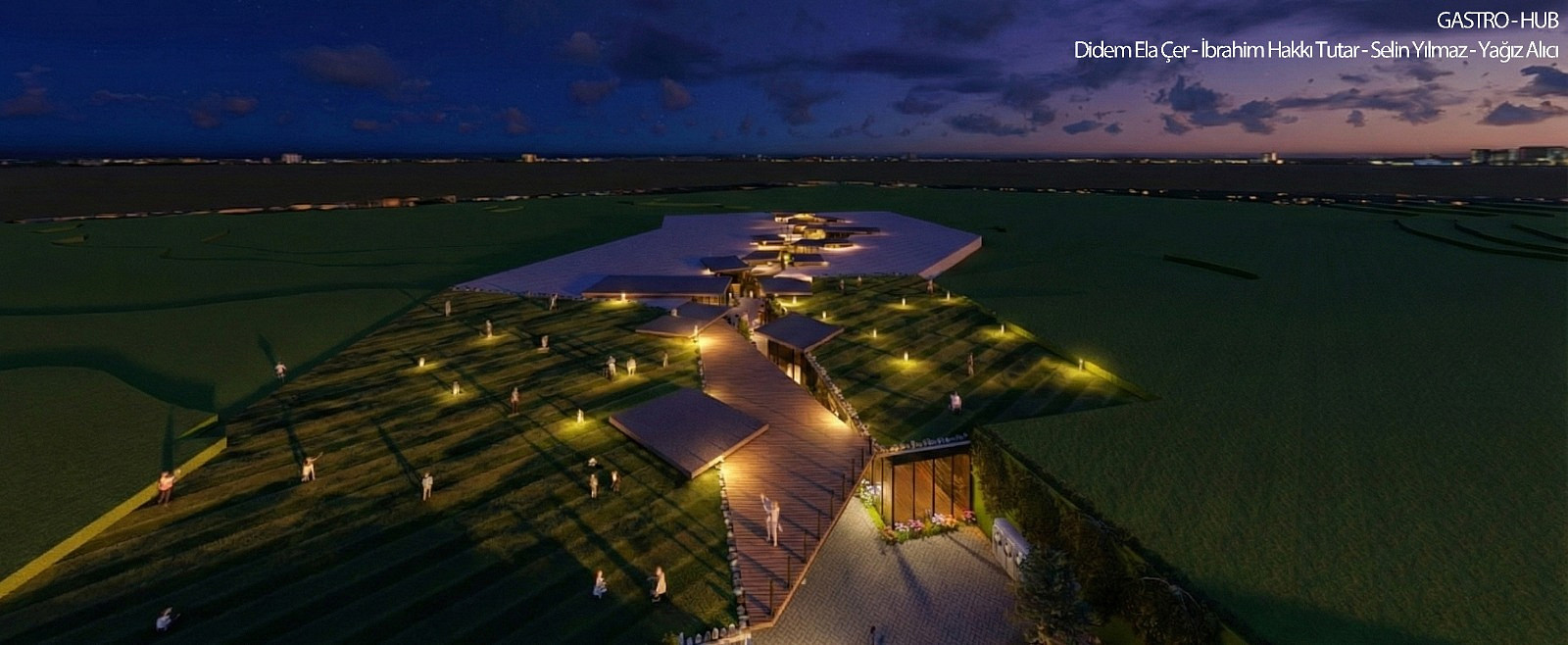
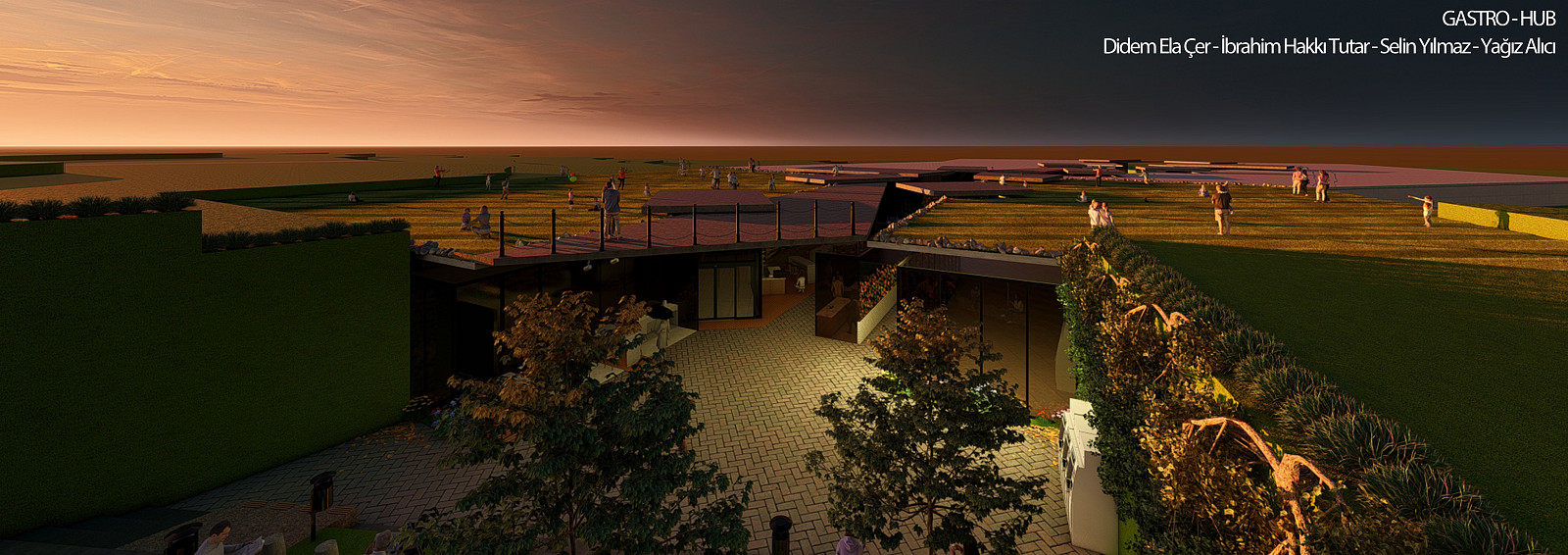
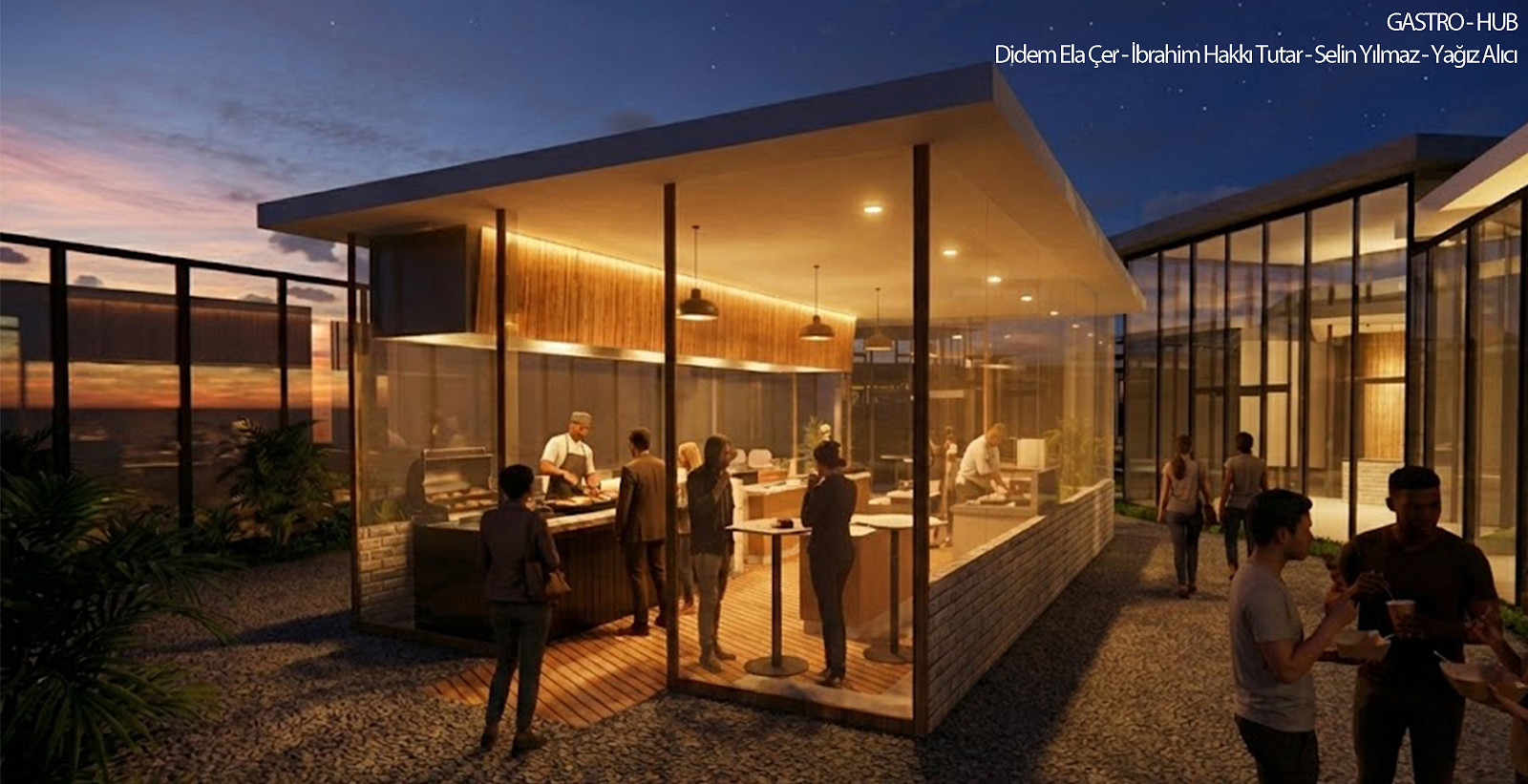
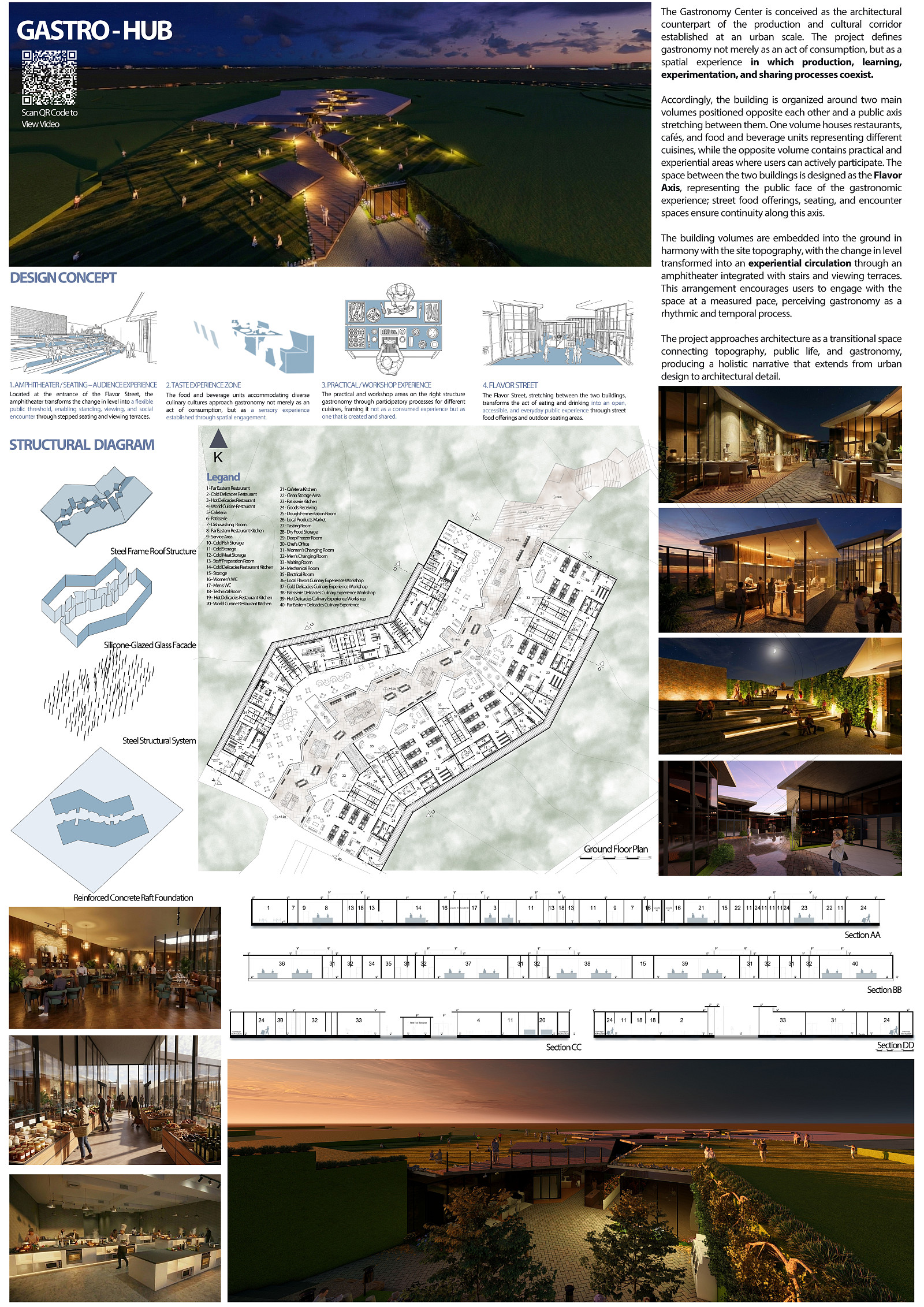
Within the scope of the design, the project site is positioned at the intersection of main pedestrian axes, strengthening public accessibility. The building program is shaped around two main masses positioned opposite each other and the “Flavors Street” located between them. One mass accommodates restaurants, cafés, and food and beverage units representing different culinary cultures, while the other mass includes practice kitchens, educational spaces, and workshop areas. This configuration aims to create an experiential spatial structure that supports users’ active participation in gastronomic processes.
The project is designed to adapt to the natural topography of the site by being partially embedded into the ground, and level differences are transformed into spatial experiences through amphitheaters, viewing terraces, and open public spaces. Continuity of user movement is ensured through open and semi-open spaces, strengthening public use scenarios.
In this context, the Gastro Hub offers a comprehensive architectural solution that makes rural production culture visible, supports public life, and creates gastronomy-based social interaction spaces.
Technical information
The Gastro Hub Project is designed with a contemporary structural system that adapts to the natural topography of the site, supports public use, and creates a flexible spatial organization. The structure is organized around two main masses and an open public axis that connects them. The masses demonstrate different heights and volumetric characteristics according to functional requirements, allowing them to adapt to various interior usage scenarios.
A steel structural system has been preferred as the main load-bearing system. The steel structure enables large spans, allowing flexible plan solutions for workshops, restaurants, and public use areas. Steel truss systems are used in the roof structure to provide both structural lightness and spatial continuity.
The foundation system is designed as a reinforced concrete raft foundation to adapt to the soil’s bearing capacity. This system aims to increase structural stability by distributing the building loads evenly to the ground.
In the façade design, a silicone glass façade system is used to maximize natural daylight and strengthen the visual and spatial relationship between interior and exterior spaces. The façade system enhances user experience while reinforcing the public character of the building.
The project integrates topographical level differences as a part of the design and supports them with amphitheaters, viewing terraces, and open circulation areas. In this way, continuity of circulation is ensured while creating social spaces where users can experience the environment.
The technical framework has been developed through a holistic approach in line with structural durability, user comfort, spatial flexibility, and environmental compatibility criteria.

Copyright © 2026 INSPIRELI | All rights reserved. Use of this website signifies your agreement to the Terms of Use, Privacy Policy, and use of cookies.