Beyond Heritage: Ruplal House as a Site of Collective Inheritance


Idea projektu
Beyond Heritage: Ruplal House as a Site of Collective Inheritance is a research-driven architectural and urban inquiry situated in Dhaka, Bangladesh, where heritage is simultaneously stabilized by law and destabilized by everyday life. The project interrogates the limitations of Bangladesh’s Antiquities Act (1968), which designates selected buildings as protected “antiquities,” often privileging legal fixity and institutional authority over lived realities, plural claims, and ecological conditions.
Rather than understanding heritage as a static monument frozen in time, the project reframes it as collective inheritance, a living, contested field where memories, occupations, adaptations, decay, and care coexist. Using the officially enlisted protected sites of the Department of Archaeology of Bangladesh as its broader context, the project foregrounds Ruplal House as a critical case study to expose the paradox of heritage governance in the global majority: while the state seeks to freeze heritage through legal recognition, everyday urban life continually unfreezes it through use, survival, and informal maintenance.
The core objective of the project is to shift heritage discourse from “heritage as an object needing protection” to “heritage as a negotiated, collective inheritance.” It aims to demonstrate how plural actors, residents, traders, state agencies, informal caretakers, and ecological systems, simultaneously shape heritage, revealing governance not as singular authority but as an uneven, ongoing process of care, repair, and contestation.
Popis projektu
The project develops a multi-scalar analytical and speculative framework to understand heritage as an evolving urban artifact rather than a monument awaiting rescue. At the city scale, it examines “enlisted protected sites” across Old Dhaka to illustrate how heritage buildings function as anchors of collective memory while being continuously reshaped by informal occupation, adaptation, and neglect.
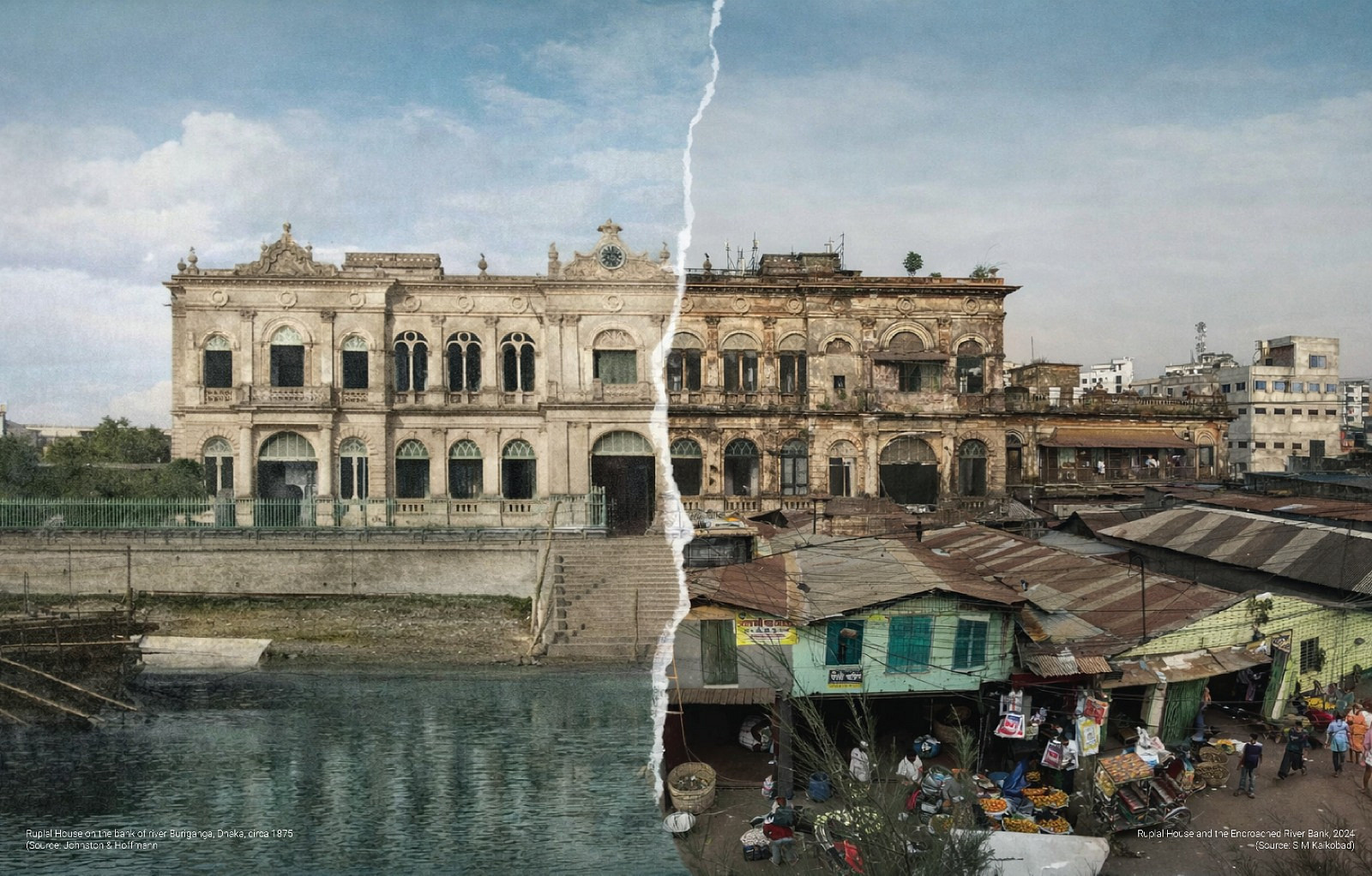
At the architectural scale, Ruplal House, an expansive nineteenth-century neo-classical mansion along the Buriganga River, is examined as a site where legal designation collides with lived reality. The building currently operates simultaneously as a market, a residence, a militarized zone, a ruin, and an ecology entangled with toxic hydrological flows. These overlapping conditions reveal heritage not as failure, but as productive friction between law, life, and environment.
Rather than proposing a singular master plan or restoration strategy, the project advances speculative scenarios of future inheritance, mapping the imagined claims of different inheritors, state agencies, local users, informal caretakers, ecological systems, and future publics. Through drawings, interviews, and visual narratives, these scenarios expose the tensions between ownership, responsibility, access, and care.
The project ultimately proposes a user-centric conservation model grounded in everyday practices of micro-maintenance, repair, and collective care already present on site. It extends this logic beyond Ruplal House by envisioning a networked system of care among historical buildings in Old Dhaka, where shared tools, skills, and maintenance rituals, such as care weeks and cooperative repair, form a decentralized heritage infrastructure. In this model, heritage is not commodified, but sustained through slow, place-bound, and collective practices.
Technické informace
The project is developed through a combination of qualitative research, spatial analysis, and speculative architectural representation. Methodologically, it integrates archival research on heritage law, interviews with occupants and institutional actors, photographic documentation, and on-site mapping of use, decay, and maintenance practices.
Technically, the project focuses on micro-intervention frameworks rather than large-scale architectural insertion. These include lightweight repair strategies, adaptive reuse tactics, and maintenance systems that can be incrementally applied without displacing existing users. The emphasis is on tools, techniques, and knowledge transfer rather than permanent construction.
Material considerations prioritize low-cost, locally available repair materials, reversible construction methods, and maintenance practices already embedded in informal urban life. Ecological conditions, particularly water toxicity, humidity, and riverine interaction, are treated as active design parameters rather than external constraints.
The proposed care network operates as a distributed system, where multiple heritage sites share resources, labor, and expertise. Government agencies such as the Department of Archaeology are repositioned not as sole custodians but as facilitators and coordinators, supporting collective action without enforcing rigid control.
Technically and conceptually, the project aligns with degrowth and decolonial approaches to heritage management, emphasizing reduced extraction, slower temporalities, and more-than-human accountability. Heritage is treated as an adaptive, living system, maintained through collective care rather than preserved through legal immobilization, ensuring that sites like Ruplal House remain active, contested, and socially meaningful within the urban metabolism of Dhaka.
Dokumentace


Copyright © 2026 INSPIRELI | All rights reserved. Use of this website signifies your agreement to the Terms of Use, Privacy Policy, and use of cookies.